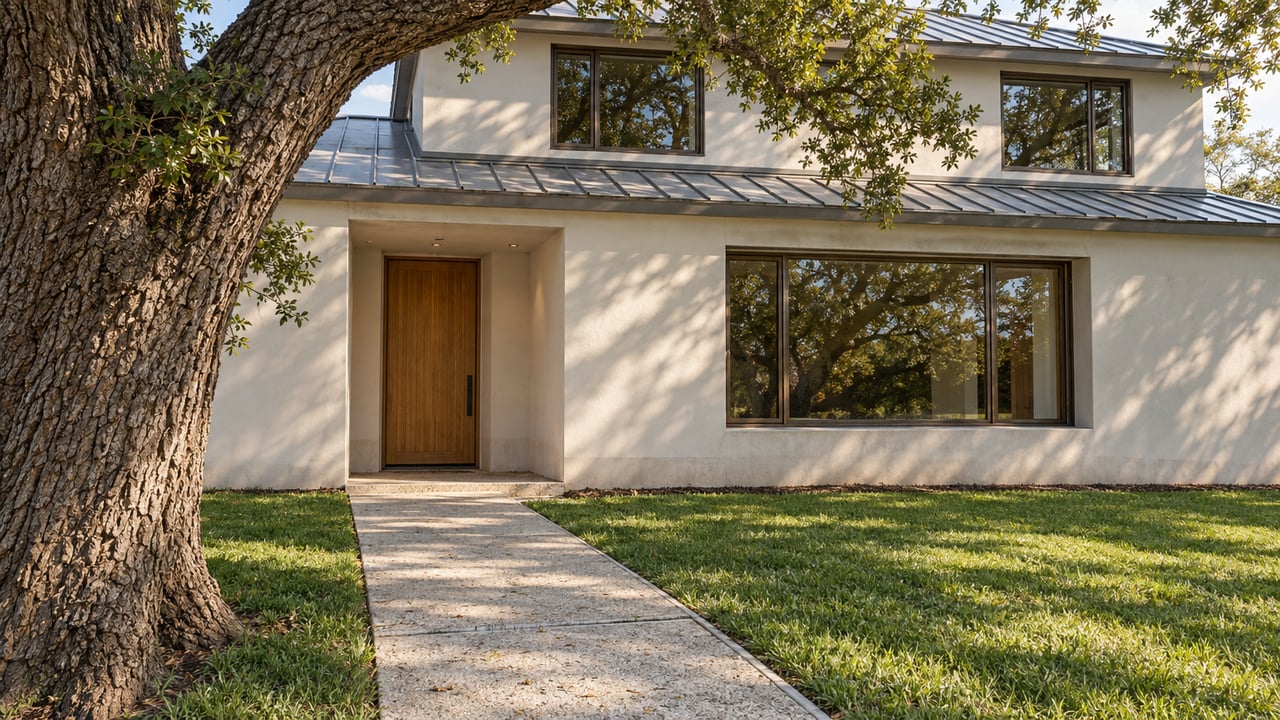
Early in 2026, a live oak on West First Street in Atlantic Beach came down to make room for construction. City records put the tree at about 240 years old with a trunk 60 inches across. News4JAX's February report quoted the city as saying the removal permit was mandatory under the objective criteria in its code. The required mitigation was more than 54 inches of replacement trees, about $9,841.88 paid into the city's Tree Protection Fund, or a proportional mix of the two.
Under the rules in place at the time, that was the whole cost. On July 13, 2026, the City Commission voted 5–0 to change that. If you're looking at an older Atlantic Beach house to tear down, rebuild, or expand, a large native tree on the lot is now a site-planning question first. A fee comes second, if it comes at all. And because of a separate stormwater rule the city adopted in October 2025, the obvious workaround of moving the house around the tree runs into a second limit.
Under the old code, paying the fee was the cheapest option
Commissioners laid out the old arithmetic during the July 13 meeting. In the meeting video, one commissioner said the mitigation fee was $150 per inch, so a 20-inch tree cost $3,000 to remove. Planting replacements runs about $450 per inch, or roughly $9,000 for the same tree. The commissioner's conclusion was that the code was "incentivizing paying into the fund rather than planting."
So on a teardown lot, a mature oak was a known line item you could plan around. Builders and buyers could price it into a pro forma and move on. Mayor Curtis Ford described the change to News4JAX in July: "Our prior tree ordinance would allow you to pay some price into the tree fund or replacement trees installed on the property as mitigation for removal of a tree anywhere on the lot and we're changing that." He went on: "We're now saying that we're going to deny removal of the tree that should not be removed." He also told the outlet that the city has "been losing our tree canopy a lot faster than we're replacing it."
What Ordinance 95-26-128 actually does
Ordinance No. 95-26-128 adds a new category to Chapter 23 of the city code. A "landmark tree" is a designated maritime species with a trunk at least 20 inches in diameter at breast height. Ford gave magnolia, live oak, pine, cedar, and cypress as examples and said invasive trees and trees not characteristic of Atlantic Beach are excluded.
For a tree that qualifies, the ordinance changes the process in four ways:
- Removal needs a permit and is "strongly discouraged." The applicant has to show that construction can't reasonably happen elsewhere on the site, or that removal is unavoidable because of site conditions or design limits outside the applicant's control.
- Relocation can be required. The city may require the tree to be moved before it approves removal, entirely at the applicant's expense, where qualified professionals find relocation feasible.
- A citizen board makes the final call. Under the amended motion, the Community Development Board grants final approval for removal, and appeals go to the City Commission.
- Mitigation costs more, especially in setbacks. The Commission adopted a 4-to-1 mitigation ratio from a table in the staff report and doubled the mitigation fee for landmark trees inside a setback.
The ordinance took effect on final reading. Here's how the change looks for a buyer evaluating a lot:
| Question on a teardown lot | Before July 13, 2026 | After July 13, 2026, for a landmark tree |
|---|---|---|
| Can the tree come out? | Yes, with mitigation | Only if the applicant shows construction can't reasonably go elsewhere on the site |
| Who decides? | Staff under objective criteria | Community Development Board, with appeal to the City Commission |
| Mitigation fee cited at the meeting | $150 per inch | $300 per inch inside a setback |
| Mitigation ratio | Varied by property category and tree size | 4 to 1, per the July 13 motion |
| Relocation | Not the standard path | Can be required, at the owner's expense |
The setback detail matters most for small lots. Setbacks are the strips along a lot's edges where the house can't go anyway, so a large oak near the front or side line sits right where the city just doubled the cost. The fee covers only the cases where removal is approved in the first place.
Moving the house collides with the stormwater rule
If the oak can't come out, the house has to fit around it. That's where the second rule comes in.
Ahead of the October 13, 2025 vote, First Coast News reported that city leaders were debating whether to scrap the requirement that new homes and major additions build on-site stormwater storage. Staff recommended keeping the rule and studying alternatives. The final version narrowed the rule without repealing it. At the October 13, 2025 meeting, Ordinance 90-25-257 passed 4–1 as amended. Under the amended Section 24-89, any development that results in more than 35% impervious lot coverage has to provide on-site stormwater storage for the entire impervious area. Projects that add less than 400 square feet of impervious surface are exempt, as long as total coverage stays within the zoning district's limit, and the 400 square feet is counted cumulatively from the ordinance's adoption date.
Put the two rules side by side. A protected tree pins part of the lot. Spreading the house into a wider, single-story footprint, or adding a longer driveway to reach a garage tucked behind the tree, pushes impervious coverage up. Once coverage passes 35%, storage applies to every square foot of hard surface on the lot, including the part that was there all along. On a small lot, that pushes the plan toward building up instead of out.
The cost of storage depends on the lot and the system. During public comment at the October 2025 hearing, one resident said compliance could top $8,000 and reach $100,000 for concealed storage systems. That was a speaker's estimate, not a city finding. It gives a sense of the range, but a civil engineer's quote on the specific lot is the real number.
As of the code library's most recent listing, which covers ordinances adopted through September 14, 2026, the July tree ordinance appears and no later amendment to Section 24-89 does. We treat the stormwater rule as adopted in October 2025 and confirm it with the city before any client writes an offer.
The tree rule is still being written
This is the friction most likely to catch buyers off guard, because nobody can quote it with confidence yet. Right before the July vote, Mayor Ford said on the record that the ordinance was "very not baked." He said getting through the process would likely take "more than a couple of months," and that "if there's a tree in question, it could be many months." He also asked what moving a tree would really cost, and said the Commission should revisit its mitigation fees because doubling them in setbacks "was just a quick thing today."
Commissioners directed staff to research what tree relocation costs and how feasible it is, including examples from other cities and contractor estimates, and to report back. The August 26, 2026 Environmental Stewardship Committee agenda still listed the ordinance and the Commission's follow-up requests, but it didn't include cost findings. So a buyer in October 2026 has a rule with real teeth, an approval timeline the mayor himself expects to run long, and a relocation requirement with no published cost benchmark.
For a seller, that uncertainty carries over to the buyer pool. A builder pricing a lot with a 30-inch oak near the middle has to account for the time a CDB hearing takes, the chance of a denial, and the chance that relocation is required. Those risks show up in the offer.
What to check before writing an offer
Having handled permitting and construction on many single-family homes, we treat these as due-diligence questions, not formalities:
- Order a tree survey early. Ask the surveyor to identify every native maritime tree with a trunk of 20 inches or more and record its species and diameter.
- Map each tree against the setbacks and the planned footprint. A landmark tree inside a setback falls under the doubled fee. A landmark tree inside the planned footprint sets off the "can construction reasonably occur elsewhere" test.
- Measure current impervious coverage. Find out how close the lot already is to 35%, and whether any additions since October 13, 2025 have used up part of the 400-square-foot exemption.
- Build the timeline into the contract. If the plan depends on a removal approval, the mayor's "many months" estimate should shape your inspection and due-diligence periods.
- Confirm current figures with the city. The $150 and $300 per-inch figures come from the July 13 meeting discussion, and the Commission has said it plans to revisit them.
None of this is legal advice. It's how the process works, so you can ask the right questions of the city, your surveyor, and your attorney.
Questions buyers ask us directly
Does every large tree count as a landmark tree? No. The definition covers designated maritime species at 20 inches DBH or larger. Ford said invasive trees and trees not characteristic of Atlantic Beach aren't protected.
Can I still just pay the fee? Not automatically. Removal of a landmark tree is strongly discouraged and has to meet the site-constraint test. Mitigation applies after removal is approved.
Is the stormwater storage requirement gone? No. The October 2025 amendment narrowed it to development that pushes lot coverage past 35%, with an exemption for additions under 400 square feet counted cumulatively.
If you're weighing an older Atlantic Beach house for its lot, send us the address before you write an offer. The Edgewater Home Team at Stephen Williams will coordinate the tree survey, a coverage estimate, and a timeline you can build into your contract. Schedule a Consultation.